


Send Message
Privacy statement: Your privacy is very important to Us. Our company promises not to disclose your personal information to any external company with out your explicit permission.
Select Language



The total solar panel cost for a project extends beyond the simple price per watt. It encompasses the initial hardware investment, structural mounting systems, installation labor, and long-term operational savings. For commercial buyers and infrastructure developers, understanding these variables is critical to accurate budgeting and ROI calculation.
The core expense involves high-efficiency photovoltaic modules. Prices fluctuate based on silicon wafer costs, manufacturing scale, and technology type (Monocrystalline vs. Polycrystalline). Bulk procurement significantly reduces the unit cost per watt.
Mounting structures, inverters, cabling, and labor constitute roughly 30-40% of the total project cost. Choosing integrated solutions, such as solar street lights with built-in panels, can streamline this process and reduce civil engineering requirements.
While upfront costs exist, solar energy systems offer decades of low-maintenance operation. The reduction in electricity bills and grid dependency typically results in a full return on investment within 3-5 years, followed by years of free energy generation.
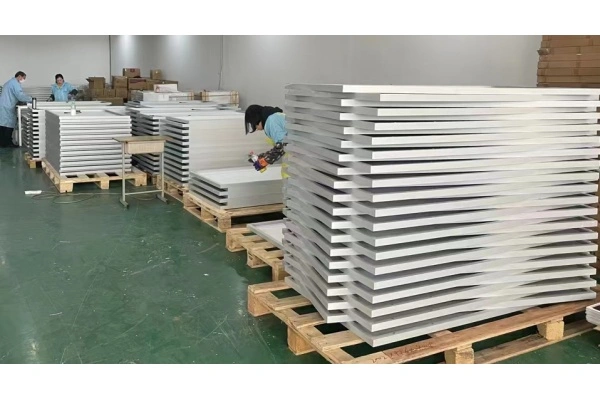
How rigorous quality control and advanced production facilities ensure consistent pricing and superior durability.
Our manufacturing facility operates under ISO 9001 and CE certification standards. This ensures that every solar panel produced meets international quality benchmarks, reducing the risk of costly replacements or failures in the field. Consistent quality directly protects your bottom line.
We utilize state-of-the-art automated production lines to minimize human error and maximize output consistency. This efficiency allows us to offer competitive pricing without compromising on the purity of materials or the precision of cell assembly.
Every batch undergoes strict testing for light-induced degradation (LID) and potential-induced degradation (PID). This ensures that the solar panels maintain their rated power output over their lifespan, maximizing the energy yield per dollar spent.
A strategic guide for procurement managers evaluating suppliers and specifications for large-scale projects.
Higher efficiency panels (18%+) generate more power per square meter. While the upfront cost per panel may be slightly higher, the reduced area requirement lowers mounting and installation costs, optimizing the overall system price.
Look for manufacturers offering 25-year linear power warranties. A robust warranty indicates confidence in product longevity and protects your investment against premature degradation, ensuring stable long-term returns.
Ensure panels meet IEC 61215 and IEC 61730 standards. Certified products face fewer customs hurdles and are eligible for government incentives in many regions, effectively lowering the net project cost.
Use this checklist to evaluate suppliers and ensure you are getting the best value for your solar energy investment.
Confirm the supplier has direct manufacturing capabilities or exclusive partnerships, avoiding middleman markups that inflate the final solar panel cost.
Request a detailed breakdown including panel cost, shipping, insurance, and taxes. Hidden fees often surprise buyers after the initial quote.
Ensure the supplier provides clear warranty claim procedures and technical support channels in your region to minimize downtime risks.
Always request pre-production samples for independent lab testing. Verify actual performance metrics match the datasheet claims before bulk ordering.
Check packaging standards to prevent transit damage. Broken panels incur replacement costs and delay project timelines significantly.
For specialized projects, verify if the supplier can adjust dimensions or connector types to fit your existing infrastructure, saving adaptation costs.
Leveraging our expertise in smart lighting and traffic facilities to deliver cost-effective solar panel systems globally.
As a leading supplier of solar street lights and LED solutions, we source high-quality solar panels directly from certified manufacturers. This vertical integration allows us to pass significant cost savings to our B2B partners.
With successful installations in Europe, Africa, Asia, and North America, we understand diverse regulatory environments and climate conditions. We recommend panel configurations tailored to your specific geographic location for maximum efficiency.
We offer full customization services, allowing you to brand solar panels or modify technical specifications to meet unique project requirements. Our design team provides free solution planning to optimize your budget.
Exploring diverse use cases where solar energy systems provide reliable, cost-efficient power solutions.
Cities worldwide are retrofitting traditional grids with solar-powered street lights. This application eliminates ongoing electricity costs and simplifies installation by removing the need for trenching and cabling.
Factories, warehouses, and logistics centers use rooftop solar arrays to offset peak daytime energy consumption. This reduces demand charges and provides backup power resilience during grid outages.
Traffic signals, surveillance cameras, and communication towers in remote areas rely on standalone solar panels. This provides a reliable power source where grid extension is economically unfeasible.
Common questions from procurement professionals regarding pricing, quality, and implementation.
The primary factors include the efficiency rating of the cells, the type of frame and glass used, the manufacturer's reputation, and current raw material market prices (such as polysilicon). Additionally, order volume plays a crucial role—larger orders typically qualify for substantial wholesale discounts.
ROI is calculated by dividing the total installation cost by the annual energy savings. Key variables include local electricity rates, average daily sunlight hours, system degradation rate (typically 0.5% per year), and maintenance costs. Most commercial projects achieve break-even within 3-5 years.
Many countries and regions offer various incentives, including investment tax credits, rebates, and feed-in tariffs. These policies vary significantly by location. We recommend consulting local energy regulations or working with our team to identify applicable benefits for your specific project location.
High-quality industrial solar panels typically last 25-30 years. Most manufacturers provide a 10-year warranty on workmanship and a 25-year linear power warranty, guaranteeing at least 80% of original power output after two decades of operation.
Yes, we offer OEM/ODM services to tailor panel specifications. This includes adjusting cell configuration to meet specific voltage outputs, modifying dimensions for limited installation spaces, and customizing connector types to match your existing electrical infrastructure.
About Us
Related Products List
Contact Us

Privacy statement: Your privacy is very important to Us. Our company promises not to disclose your personal information to any external company with out your explicit permission.
Fill in more information so that we can get in touch with you faster
Privacy statement: Your privacy is very important to Us. Our company promises not to disclose your personal information to any external company with out your explicit permission.